News
September 28, 2026
An open fall may offer Manitoba farmers a chance to turn marginal acres into opportunity
BRANDON, Sept. 2026— For Manitoba farmers looking for ways to get more from every acre, late fall can be the right time to tackle fields that consistently struggle to produce a profitable crop.
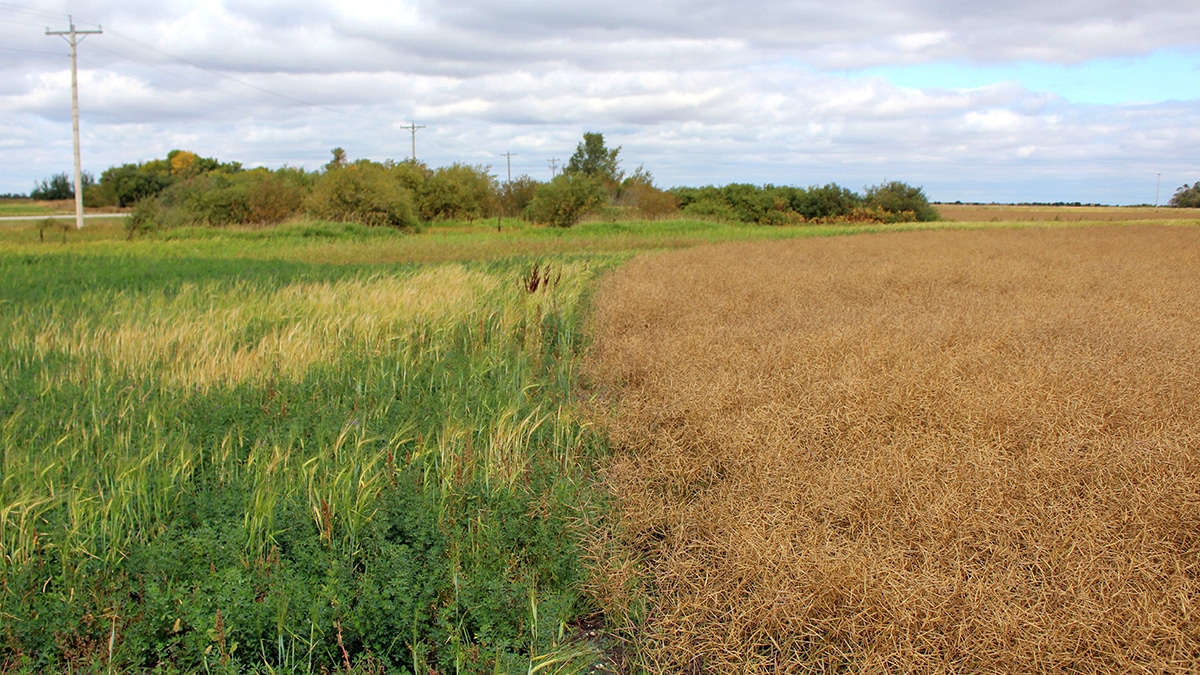
Flood prone, weedy, saline areas can quietly eat into farm profitability year after year. Rather than continuing to apply crop inputs and fight with wet, saline acres that simply don’t pay, farmers can consider perennial forages as a longer-term solution.
Ducks Unlimited Canada (DUC) is encouraging farmers to take advantage of the fall window for dormant seeding as part of its Marginal Areas Program.
“Some acres aren’t as well suited to growing annual crops year after year,” says Daphne Appleyard, a marginal areas specialist with DUC. “Fall is a good opportunity to start changing that equation by establishing perennial forages. Perennials reduce the need for annual crop inputs, provide ground cover to reduce erosion and weed pressure, and deep roots use moisture more efficiently than annual crops while mitigating nutrient losses from runoff.”
Marginal acres are widespread across the Prairies. Research by DUC partners estimates that about 13 acres in every quarter section are marginal farmland—millions of acres across Manitoba, Saskatchewan and Alberta that remain persistently unproductive despite fertilizer, crop protection products and careful management.
For farmers, those areas can represent a significant financial loss. Perennial forages provide another option, putting those acres to work while protecting the soil and building a productive forage stand.
Get the timing right
Dormant seeding is designed to put seed in the ground late enough in the fall that it remains dormant until spring.
Although field margins may be currently saturated in some areas, Manitoba soils have a natural ability to infiltrate surface water. And field conditions can change quickly. If long-range weather forecasts hold, prairie farmers could expect to see an open fall with time post-harvest to reclaim challenging acres before freeze up.
Soil temperatures and field conditions should be closely monitored and Appleyard recommends waiting until soil temperatures are below 5C. “You want to seed late enough that the seed stays dormant, while still ensuring good seed to soil contact. Planting too early can allow seed to germinate prematurely during a warm spell, increasing the risk of winterkill.”
A diverse forage mix that incorporates both salinity and moisture tolerance will improve establishment, particularly on field edges or wetland margins. DUC recommends using both grasses and legumes and increasing the seeding rate to mitigate potential establishment losses.
Farmers should also keep expectations realistic. Saline-tolerant perennial forages can take two to three years to fully establish and some areas may need touch-up seeding.
“Rehabilitating marginal acres is a process,” says Appleyard. “The goal is to establish a competitive perennial stand that fills in bare areas and gradually outcompetes weeds. It may take some patience, but the long-term payoff can be worthwhile.”
Rebates and ag support available
DUC offers rebates to farmland owners looking to address marginal acres, including areas affected by excess moisture and salinity. A bonus discount is available when sourcing seed through Nutrien, and additional incentives may apply to land financed through Farm Credit Canada.
In Manitoba, the Marginal Areas Program is supported in part by funding from Manitoba Habitat Conservancy (MHC) through the Conservation Trust. Established by the Province of Manitoba, the Conservation Trust is an innovative way to fund nature-based approaches to climate change mitigation and habitat conservation.
Beyond rebates, DUC provides one-on-one agricultural extension support tailored to each farm’s specific needs including seed blend, establishment logistics, and ongoing management recommendations.
“Whether you’re dealing with flooding, salinity, or field compaction issues, every marginal acre has its own challenges,” says Appleyard. “We can work with farmers to look at the conditions they’re dealing with and find a forage and management approach that makes sense for their operation.”
For more information about DUC’s Marginal Areas Program, available funding and agronomic support, visit https://ag.ducks.ca/program/marginal-areas-mb/ or contact DUC’s Brandon office at 204- 285-9779.